As a researcher, I believe the more voices in the course materials space the better. Regardless of which course materials intervention you support, you must recognize that the all have a place in the course materials landscape. For example, there are many great people working on the reducing the cost of course materials through concepts of open education and open educational resources (OER). However, their opposition to Inclusive and Equitable Access unnecessarily vociferous. OER proponents’ opposition to the use and adoption of Inclusive and Equitable Access course materials models ignores the effectiveness research that shows these programs have significant impact on student outcomes (InclusiveAccess.org, n.d.; Swaak, 2021) and ignores the lack of significant OER effectiveness research.
Effectiveness Research
Effectiveness research on OER is incredibly mixed and lacks the statistical significance (Gurung, 2018; Hilton, III, 2016) of the available Inclusive and Equitable Access effectiveness research. The lack of significance in the OER effectiveness research has OER proponents and Inclusive and Equitable Access detractors yelling about costs and fearmongering.
Opposition Cost Myth
Opponents of Inclusive and Equitable Access argue that the cost of Inclusive and Equitable Access content will still “be unaffordable for some students”. It is likely true that some students can’t afford materials regardless of model, but it is more likely that Inclusive and Equitable Access programs open access to course materials to millions and millions of more students than the traditional course materials acquisitions model. OER has yet to be able to cover all the courses in an institution in the way that Inclusive and Equitable Access can. So, while OER may impact cost savings for a handful of classes, OER cannot impact cost savings across an entire campus the way Inclusive and Equitable Access can.
One of the points that is frequently ignored when talking about the cost of OER materials is their reliance on grant funding. If grant funding dries up for the content curation, what happens to that content? Flat World Knowledge was known for their free OER course materials, but now they charge for the materials. While only one example, and I could be accused of cherry-picking, it is an example where an OER model that was supposed to be free, now has a fee associated with it.
Drumming Up Faculty Fear
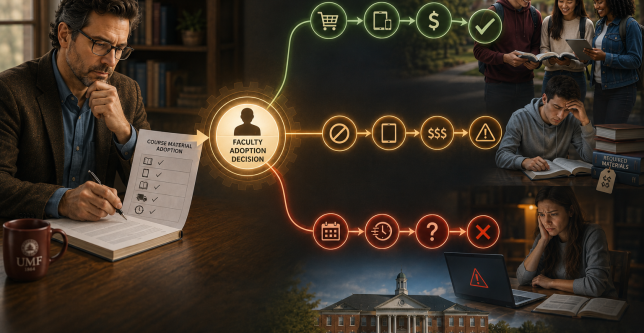
Opponents of Inclusive and Equitable Access also use the fear of loss of academic freedom for faculty. If an institution requires faculty to use a particular book, like in the case of common book programs, that is a discussion between the faculty member and the institution. Are common book requirements, where all sections of a course use the same book, better for Inclusive and Equitable Access programs than using multiple books for the same course? Yes. However, Inclusive and Equitable Access programs still allow for the flexibility and freedom to choose the right materials for each instructor and course.
Opponents of Inclusive and Equitable Access also use the fear of loss of academic freedom for faculty. If an institution requires faculty to use a particular book, like in the case of common book programs, that is a discussion between the faculty member and the institution. Are common book requirements, where all sections of a course use the same book, better for Inclusive and Equitable Access programs than using multiple books for the same course? Yes. However, Inclusive and Equitable Access programs still allow for the flexibility and freedom to choose the right materials for each instructor and course.
Mythical Blockades
There is an argument that opting out of Inclusive Access or Equitable Access programs blocks students from “getting critical course materials”, when in fact, opting out of these programs simply means students revert back to the traditional course materials acquisitions model that still dominates how students acquire their course materials. There is no monster standing between a student and obtaining their course materials from other sources. There is also this fear that Inclusive and Equitable Access programs limit access to course materials after the course ends, which completely ignores decades and decades of buyback programs which has allowed students to pocket millions of dollars. Opt-out laws provide students with the protection necessary to make the best choice for themselves.
Student Outcome Blindspot
I will never argue that there are not specific issues associated with Inclusive and Equitable Access programs, but opponents to Inclusive and Equitable Access programs leave out the critically important issues of student outcomes associated with these programs. OER research generally uses terms like “as good as” or “does no harm” when speaking about the interactions observed between OER interventions and student outcomes. However, Inclusive and Equitable Access effectiveness research has continually proven that these programs increase student success rates and course completion. You can visit my research page to examine the effectiveness research on Inclusive and Equitable Access programs for yourself.
Cost is just one part of the OER and Inclusive/Equitable Access conversation, but what costs to student outcomes are we willing to accept?
As always, thanks for being here and I am looking forward to the next time.
– MM
References
Gurung, R.A.R. (2018). Open educational resources: What we don’t know. Inside Higher Ed. Retrieved from https://www.insidehighered.com/digital-learning/views/2018/11/14/what-we-dont-yet-know-about-open-educational-resources-opinion?v2.
Inclusiveacces.org. (n.d.). Myths vs. Facts. Retrieved from https://static1.squarespace.com/static/60ca9897f09c9766ed86da32/t/6163a74c52235f0a5e2daa2e/1633920845474/InclusiveAccess.org-Myths-vs-Facts.pdf.
Swaak, T. (2021). Do ‘inclusive access’ textbook programs save students money? A new site urges everyone to read the fine print. The Chronicle of Higher Education. Retrieved from https://www.chronicle.com/article/do-inclusive-access-textbook-programs-save-students-money-a-new-site-urges-everyone-to-read-the-fine-print?cid2=gen_login_refresh&cid=gen_sign_in.